 Oak Island Golf Cart Repair
Golf Cart Brakes and Tires in Oak Island
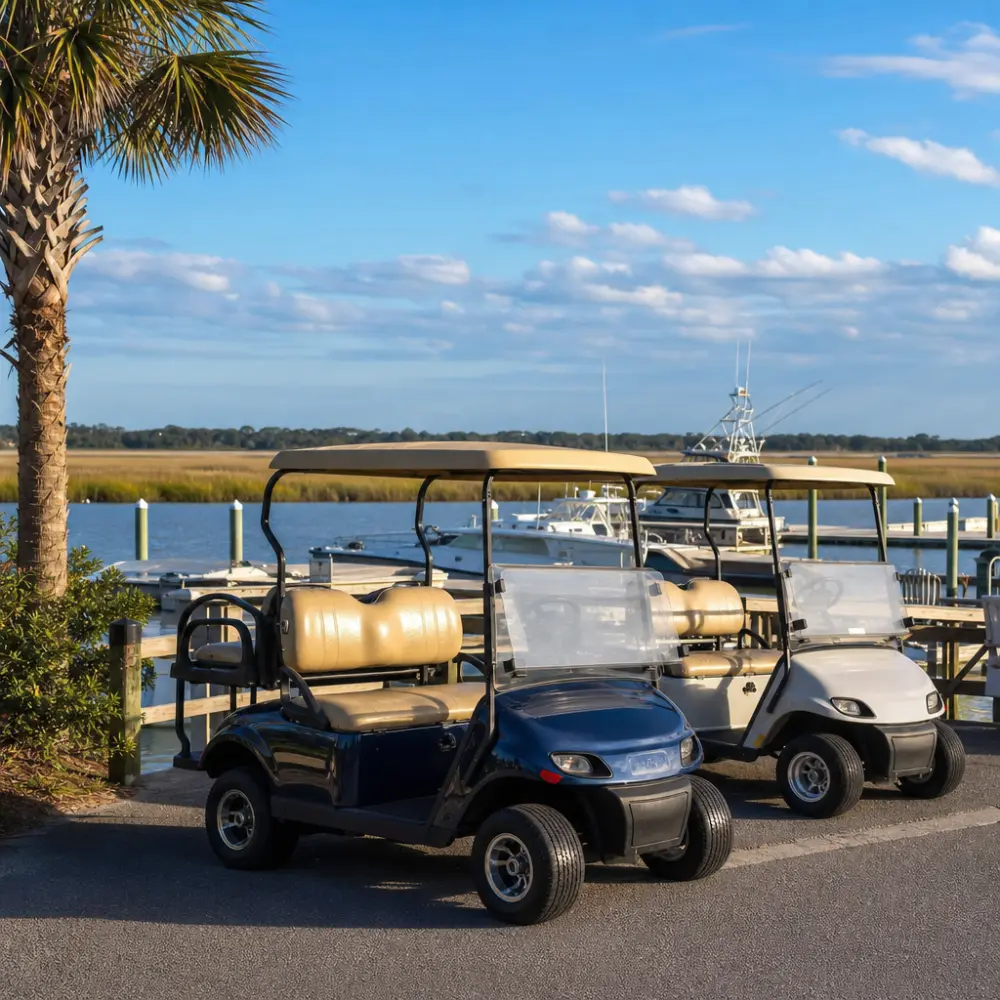
Oak Island Golf Cart Repair adjusts, repairs, and rebuilds golf cart brakes and mounts new tires in your driveway anywhere in Oak Island and Brunswick County. Brake adjustment about $75, shoes and drums $100 to $250, full overhaul $200 to $400. Tires $75 to $150 each installed, $300 to $600 for a set of four. The $50 to $100 service call includes the inspection and is usually applied toward the work.
Brakes and tires are the wear items a barrier island punishes hardest, and any cart being made street legal here has an inspection-shaped reason to keep both in order. Here is what wears, why, and what it costs.
Sand is the problem, and it is everywhere
This is a barrier island and the towns behind it, so sand is not a feature of the landscape, it is the landscape. It also does not stay on the ground. It rides in on tire tread, falls into the brake drums through the backing-plate gaps, and settles at the bottom of the drum where the shoes sweep through it on every stop.
The result is a grinding-compound effect: shoes wear faster, drums glaze or score, and the brakes start to squeal, then grab, then fade. The giveaway is the sound. Worn shoes squeal. Sand sounds dry and gritty, and it arrives well before the mileage says it should. A cart kept on paved streets sees a little of this; a cart that crosses sandy ground daily sees a lot. The same sand packs into wheel bearings and pedal linkages.
Salt adds the second layer, and it is worse than pine straw ever was. Salt-laden humid air corrodes brake cables inside their housings, seizes cams and adjusters, and rusts the springs and hardware that are supposed to move freely. A partly seized cable leaves one brake dragging permanently, which wears that shoe, quietly costs range, and gets blamed on the battery pack every single season. A two-minute roll test finds it.
Brake work, what each level covers
Adjustment, about $75. Most golf carts use mechanical drum brakes on the rear wheels, actuated by a cable from the pedal. As shoes wear, pedal travel increases and stopping distance grows. An adjustment takes up the slack at the cable and the shoe adjusters, cleans the sand out of the drums, frees the cams, and resets the parking brake. It is the right fix for a cart that stops but takes a longer pedal than it used to.
Shoes and drums, $100 to $250. When the lining is worn to the rivets or the drum is scored, adjustment will not help. The job is new shoes, resurfaced or replaced drums, cleaned and lubricated backing plate hardware, and a final adjustment. This is the most common brake job on a coastal cart that is four or more years old.
Full overhaul, $200 to $400. Shoes, drums, cables, springs, cams, and hardware. This is for carts where the cable has stretched or rusted, the cams have seized, or the hardware has corroded to the point that nothing moves right. It is also what a neglected cart usually needs after sitting through a couple of humid summers.
Every brake job ends with a hard-stop test, and with the parking brake checked on a slope, because a driveway ramp or a bridge approach is where a parking brake that does not hold gets discovered otherwise.
Why brakes matter more on a street-legal cart
Oak Island permits only registered low-speed vehicles on public streets, and “safe tires and approved brakes” are on the Town’s own equipment list alongside the lights, mirrors and seat belts. An LSV also has to pass an inspection at an authorized station before the DMV will plate it, so brakes and tires are not a judgement call here, they are a pass or fail.
Southport, which does register golf carts, inspects them annually too. And on any public street a cart is the smallest, slowest, least protected thing out there, sharing the road with cars, cyclists and people walking dogs. A cart that runs on a public street deserves a hard-stop test at every visit, and you should be told plainly if it fails. The rules, town by town, are worth reading before you assume yours is legal.
Tires, and what this climate does to them
Sand scrubs tread. On paved streets a golf cart tire lasts years; on sandy paths the same tire can show visible wear in a season. Low pressure makes it worse, because an underinflated tire flexes more, runs hotter, and wears the shoulders. Most cart tires want 18 to 22 psi depending on size and load, and it is common to find carts running at 10.
The most common tire jobs:
| Job | Price | Notes |
|---|---|---|
| Single tire, standard size, installed | $75 to $150 | Mounted and balanced on-site |
| Set of four, standard | $300 to $600 | Includes pressure check and torque |
| Lifted or low-profile styles | Quoted | Larger sizes, specialty wheels |
| Flat repair | $30 to $60 | Plug or patch where the tire is worth saving |
| Pressure and wear check | Usually included with any visit | Typically free with the diagnostic |
Turf tires, street tires, and all-terrain tread each suit different carts. A cart that spends most of its time on Oak Island No. 6’s cart paths and neighborhood streets does fine on a street or turf tread. A cart on unpaved trails or property work out toward Bald Head Island wants a more aggressive tread and a heavier ply rating. Standard sizes are easy to find; specialty sizes usually have to be ordered.
The visit
- Describe the symptom: squeal, grab, long pedal, pull to one side, visible tire wear, or a flat.
- Our tech arrives with shoes, drums, cables, and standard tires on hand.
- A proper brake job includes a drum cleanout and hardware lubrication; a proper tire job includes a pressure check on all four and a torque check.
- A hard-stop test on a slope before we leave. Ask to watch it.
The service call is $50 to $100 depending on where you are in Brunswick County, typically includes the inspection, and usually comes off the bill when you approve the work. Full tables are on the pricing page.
Combine it with a tune-up
Brakes and tires are two of the six items in the annual tune-up service, which also covers battery watering and load testing, terminals, lights, and connections for $100 to $200 on an electric cart. If your cart is due for both, the tune-up is the cheaper way in. The Brunswick County maintenance calendar suggests a spring brake-and-tire check after the pollen clears and a fall check before the cold.
Book brake or tire service
Describe what the cart is doing and where it lives, paved street or sandy path, and send a photo of the tire tread if wear is the question. You will get a flat price and a window, timed to that week’s schedule, anywhere in Oak Island, Southport, Caswell Beach, St. James, Boiling Spring Lakes, or Bald Head Island. For anything beyond brakes and tires, the mobile repair page covers the full visit.
Frequently Asked Questions
How much does golf cart brake work cost?
A brake adjustment runs about $75, new shoes and drums $100 to $250, and a full overhaul with shoes, drums, cables, and hardware $200 to $400. All of it is done in your driveway, and the $50 to $100 service call is usually applied toward the job.
How much are golf cart tires installed?
$75 to $150 per tire installed for standard sizes, or $300 to $600 for a set of four. Lifted and low-profile styles run higher. Our techs mount and balance on-site.
Why do my brakes squeal or grab?
In Brunswick County it is usually sand. Fine sand rides in on the tires and packs into the brake drums, where it grinds the shoes and glazes the drum surface. A cleanout and adjustment fixes early cases; worn shoes need replacing. Grabbing can also be a seized cam or a stretched cable.
How often should brakes be checked here?
Once a year for a street or path cart, and sooner if it lives on unpaved community trails. Sand wears shoes faster than pavement, and a $75 adjustment caught early is a $400 overhaul avoided.