 Oak Island Golf Cart Repair
Oak Island Golf Cart Repair comes to your driveway, garage, or cart shed anywhere in Oak Island and Brunswick County and fixes the cart on-site: batteries, brakes, tires, chargers, solenoids, motors, and controllers. Expect $1,200 to $1,800 installed for a full lead-acid pack, $75 to $400 for brake work and $75 to $150 each for tires, and we usually credit the $50 to $100 service call toward your repair. Describe the symptom on the form so we can bring the likely parts; if one must be ordered, expect a second visit.
A cart on a barrier island is not a golf accessory. It is how people get to the beach access, the marina, the neighbour’s house, and back, and when it quits it takes the short trips with it. That is why everything here is mobile: the cart that will not move is exactly the cart that cannot be brought to a shop.
What gets fixed, at your home
- Mobile golf cart repair: the core service. On-site diagnosis and repair of whatever is wrong: will not move, will not charge, losing range, strange noises. All major brands, electric and gas.
- Battery replacement: new lead-acid packs installed with haul-away of the old cores, plus honest lead-acid versus lithium math for carts that log real daily miles.
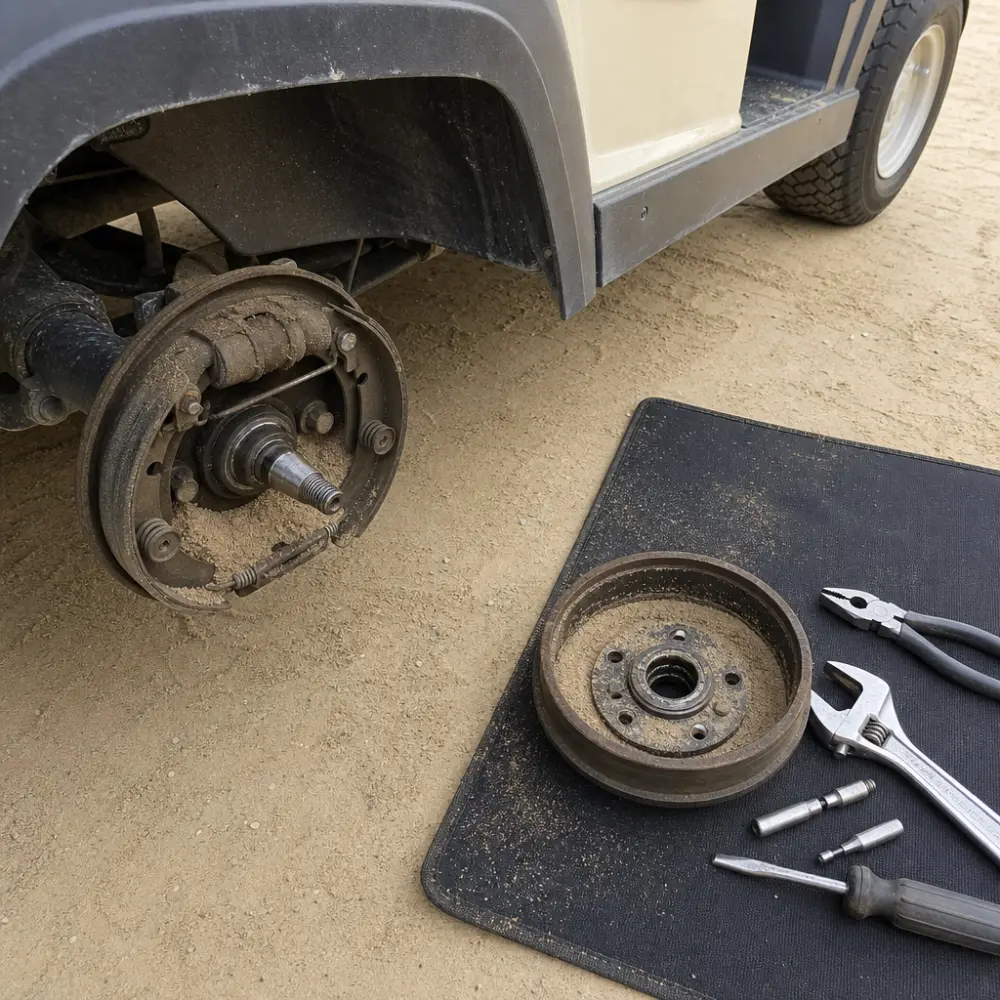
- Brakes and tires: we adjust the brakes, swap shoes and drums, and mount new tires without the cart leaving your driveway. Sand wears both faster than owners expect.
- Motor and controller repair: solenoids, speed controllers, and drive motors diagnosed properly before anything gets replaced.
- Charger repair: carts that “will not take a charge” are often a charger, a charge port, or a corroded connection, not a battery problem. Insist on a test before anyone sells you anything.
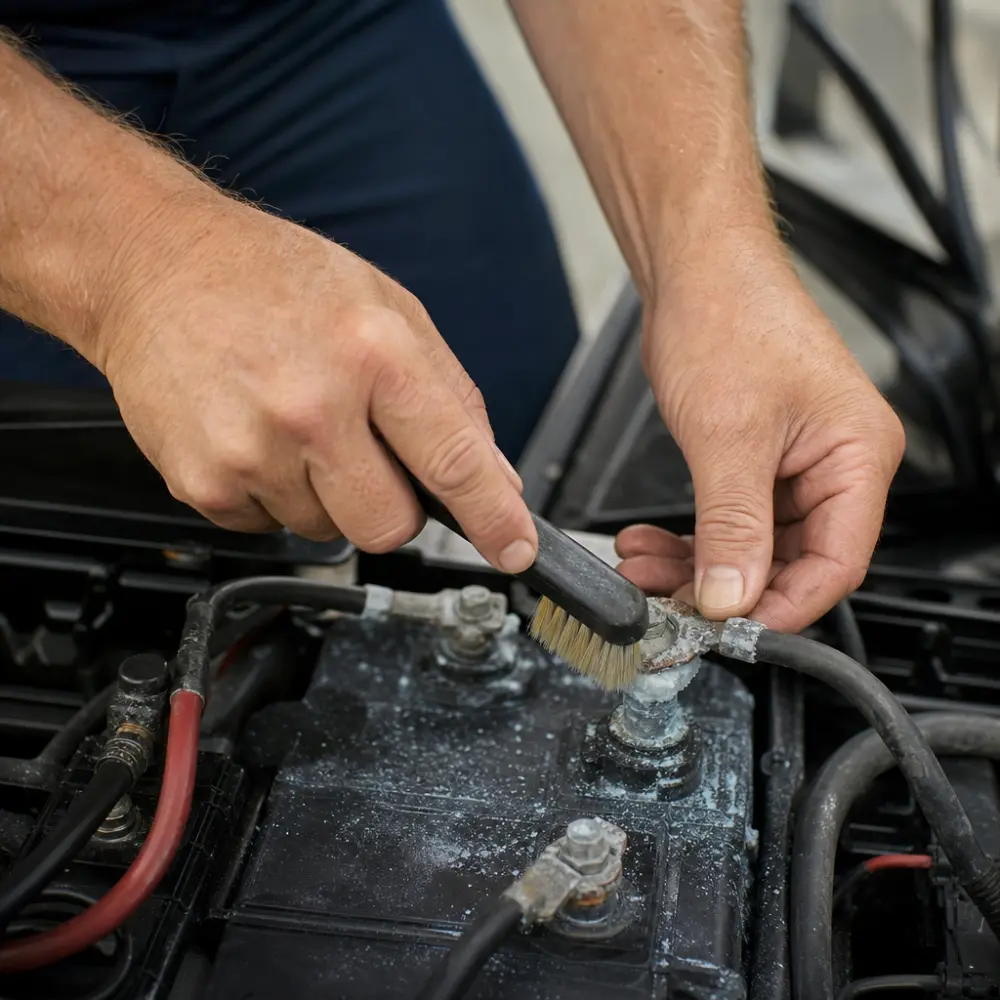
- Tune-up service: the coastal annual. Battery water and load test, terminals cleaned and coated, brakes, tires, lights, and a salt-and-sand inspection that matters more here than it does inland.
Every range we charge sits on our pricing page. Plenty of shops make you call for a number. Here you see it first.
Why coastal carts break the way they do
Salt air is the local variable, and it is not subtle. Salt-laden humid air corrodes every metal contact on a cart continuously, driven or not: battery terminals and cable lugs, charge port pins, brake cables and hardware, lighting grounds and connectors, and the fasteners holding it together. The mechanism is worth understanding once, because it explains most coastal cart failures. Corrosion at a connection is electrical resistance. Resistance in a circuit carrying several hundred amps means heat and voltage drop. So a corroded terminal does not present as corrosion, it presents as a cart that clicks and will not move, cuts out under load, or seems to have lost its range while the pack is perfectly healthy. Owners shop for a $1,600 pack when the fix is a $75 to $150 cable and terminal service.
The ground is sand, and sand gets into everything. Fine sand rides in on the tires and settles into brake drums, wheel bearings and pedal linkages, where it behaves like grinding paste against shoes and drum surfaces. The tell is a dry gritty sound rather than a squeal, and shoe wear that shows up earlier than you expected. A cart that lives on sandy streets and driveways needs brakes and tires looked at every year, not every third year.
Summer heat shortens battery life. Heat speeds up the chemistry inside a flooded lead-acid battery: water evaporates faster, and once the electrolyte drops below the plates, the exposed lead sulfates and permanently loses capacity that no charger recovers. Heat also raises self-discharge, so a cart that sits two weeks in a hot garage in August comes back lower than it was left. Watering every two to four weeks from May through September, distilled water only, after charging, is the cheapest thing you can do for a pack that costs four figures to replace.
Winter is when a weak battery finally admits it. Cold does not damage a healthy lead-acid pack, but it does cut the current the pack can deliver, which is why a pack that felt fine in October strands someone on the first properly cold morning. A discharged battery is also far more vulnerable to freezing than a fully charged one, which is the argument for a maintainer on a cart that sits through the winter. If your cart hesitates on the first press of the pedal on a cold morning, that is a load test waiting to happen.
A lot of carts here sit. Houses occupied part of the year, carts that stay with a rental property, carts used hard for three months and parked for nine. A flooded pack left partly discharged sulfates, and hardened sulfation is permanent. Sitting badly costs more packs in this county than driving hard does, and the sat all season page explains what comes back and what does not.
Storm season is real. Hurricane season runs 1 June to 30 November, and a tropical system does not need to make landfall to put salt spray, wind-driven rain and standing water where you would rather it were not. After a system: check the terminals, check the charge port, and roll test for a brake that seized while the cart sat wet. If the cart stood in salt water at any depth, do not charge it. Call someone first. The maintenance calendar lays out the whole year.
Oak Island’s cart rules, and what they mean for repair
This is the single most misunderstood thing in the area we cover, and it is worth being blunt about.
Under North Carolina law a golf cart has no general right to public streets. A town has to pass an ordinance permitting and regulating them before they may be used on its streets at all. A low-speed vehicle (LSV) is a different legal class defined in G.S. 20-4.01: four wheels, a top speed greater than 20 mph but less than 25, meeting the federal safety standard for the class. Under G.S. 20-121.1 an LSV must be titled, registered, insured and plated with the DMV, driven by a licensed driver, and may run on streets posted 35 mph or less.
Oak Island has gone the LSV route. Unregistered, non-street-legal golf carts are not permitted on public streets here. A registered LSV is, and it needs no extra town permit because the State has already plated it. The Town’s guidance says an LSV must carry seat belts, head, tail, brake and turn lamps, a windshield and wipers, rear view mirrors, a horn, a speedometer, and safe tires and brakes. Getting there means equipping the cart, obtaining a VIN from an authorized retailer, passing an inspection, insuring it, and taking the paperwork to the DMV for a plate. There is a separate Mobility Device registration through the Police Department for a cart operated by someone with a mobility impairment.
The neighbours are not the same. Southport does permit golf carts on city streets, with annual inspection and registration, currently $50 a year, proof of insurance, a $25 late fee after 31 March, and a minimum driver age that the aldermen lowered from 18 to 16 in August 2026. Bald Head Island allows electric carts only, gas carts are prohibited on Village streets, with annual Village registration and an 18 mph island-wide limit. The full breakdown, town by town, is in the guide to the rules.
For repair the practical version is this: on Oak Island, compliance is mechanical work. Lights, turn signals, mirrors, horn, wipers and brakes that genuinely stop the cart are not accessories, they are the difference between a plated vehicle and a driveway cart. Lighting circuit repair, which on this coast means corroded grounds and connectors far more often than bulbs, runs $75 to $200. Before converting, ask plainly whether the cart is worth it. An older cart with a tired pack and worn brakes usually is not.
Who drives carts here
The cart population splits into groups that fail differently, and the diagnosis often starts with knowing which one you are.
Beach-town carts that live near the water and take the full salt load, many of them at houses that are occupied part of the year or rented out. Community carts at St. James, which are the highest-mileage carts in the area: used as daily transport inside a community built around cart paths, charged nightly, and therefore spending lead-acid cycle life at a rate no weekend cart approaches. Inland carts at Boiling Spring Lakes, where sand and pine debris matter more than salt. And Bald Head Island carts, which are not a convenience at all but the only vehicle on a car-free island.
Each town gets its own page because each one genuinely is different.
How a mobile visit works
- Describe the symptom. Will not move, clicks but no go, will not charge, losing range, squeals when braking. Most problems narrow down fast from a good description, so our tech arrives with the likely parts.
- We come to you. Driveway, garage, or cart shed, at a scheduled window: anywhere in Oak Island, Southport, Caswell Beach, St. James, Boiling Spring Lakes, or Bald Head Island. The $50 to $100 trip fee normally includes the diagnostic and is usually applied to the repair.
- Diagnosis comes before any recommendation. A load test on each battery, voltage checks across the pack, a charger output test, solenoid and controller checks. The goal is to isolate the actual fault, not sell the most expensive maybe.
- A flat quote, then the fix. Our techs usually carry battery sets, solenoids, brake shoes, and tires. Approve the number and most jobs can be done in that same visit.
- Finish clean. Lead-acid packs get watered and terminals cleaned and coated, everything gets a torque check and a test drive, and old batteries leave with us for recycling.
Straight answers, published prices
Two things we will not do.
We will not pretend to be something we are not. Oak Island Golf Cart Repair is an independent service, not an authorized dealer or warranty center for Club Car, E-Z-GO, Yamaha, ICON, or Evolution. A cart still covered by its factory warranty should go back to the dealer who sold it for that work.
And nobody should sell you parts you do not need. A cart that will not charge deserves a charger and charge-port test before anyone talks about a battery pack. A weak cart deserves a per-battery load test, and on a flooded pack a hydrometer check cell by cell, before six batteries are condemned when one is the problem. Voltage sag under load, a chattering solenoid, and a corroded main positive cable each masquerade as “dead batteries,” and telling them apart is the actual skill you are paying for. If a repair does not make sense against the value of an old cart, we will say that too.
More on how we work is on the about page, and the FAQ answers the most common questions.
Get a fast quote
On Oak Island the usual call is a cart that will not leave the garage. Send the brand, the model year if you know it, whether it is a 36V or 48V electric or a gas cart, and what it is doing. Snap a picture of the dash or under the seat where the batteries live, if you can. We come back with a flat number and a scheduling window; how soon depends on that week’s bookings anywhere from Oak Island to St. James to downtown Southport.